Revenue on Base
Base is one of the most rapidly developing on-chain ecosystems capturing attention, capital, and acting as a proof-of-concept that artificial onchain life exists.
TL;DR
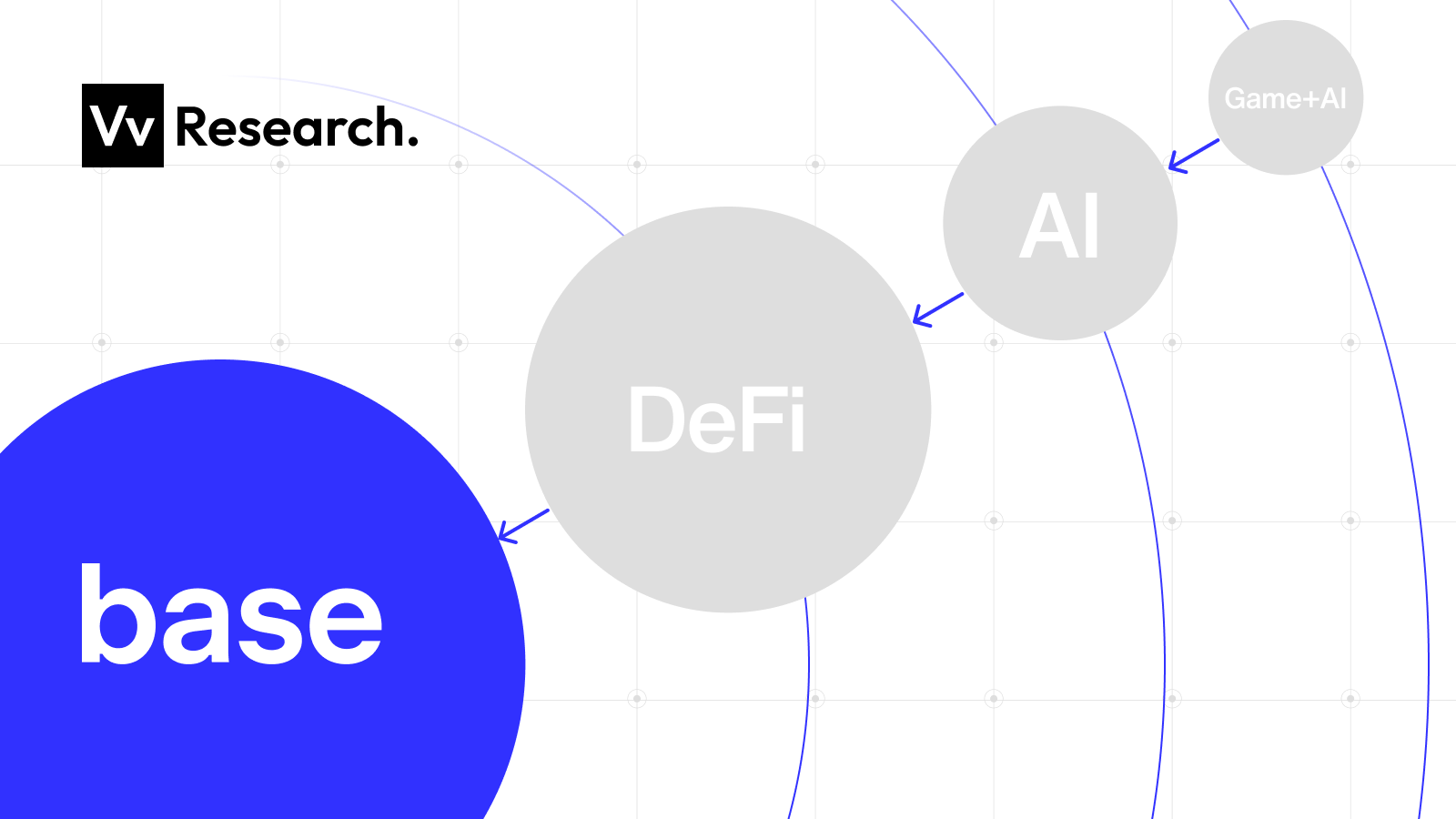
Base apps' revenue structure can be framed as a "solar system": value is captured across interconnected layers, with flows between them.
- DeFi: Base-native protocols increasingly compete with external deployments, helping retain revenue within the ecosystem, while large multichain players often extract value outward.
- AI: Virtuals and Venice currently lead in revenue generation. A newer "meta" is emerging around custom agents, with some products distributing proceeds to token holders.
- Game + AI: Still early in revenue terms, but already showing strong social traction and a credible path to becoming a meaningful contributor with Clash of Coins ($OWB) as a key example.
Disclaimer: Valueverse is not affiliated with or otherwise connected to any of the projects referenced in this report. Valueverse has not received any compensation (financial or otherwise) from any such project, and this material reflects our independent research provided solely for educational and informational purposes.
Base: the Solar System of Revenue
On Base, we identified three core revenue-generating sectors:
Outline:
-
DeFi sector: the most established layer. It underpins economic activity across the ecosystem: value exchange, capital markets, and yield generation.
-
AI sector: a layer of AI-driven innovation that is increasingly embedded in economic activity. Agentic protocols and standalone agents provide services, transact with one another, and deliver outcomes for both agents and humans. Agents typically rely on DeFi as the settlement and liquidity layer for their economic operations, making AI a growing source of on-chain activity and revenue.
-
Game + AI sector: an emerging gaming layer built on top of Base-native AI infrastructure, enabling new in-game experiences. It can feed demand and value back into both the AI and DeFi layers through payments, assetization, and agent-driven gameplay loops.
Prediction markets on Base have seen limited traction compared to other ecosystems or centralized platforms. It is connected with competition complexity with major platforms such as Polymarket/Kalshi, liquidity issues, and regulatory uncertainty.
Base: Defi Sector Revenue
In this section we observe key Defi projects operating on Base, excluding yield aggregators, and risk curators.
| Project | Base native | Description | Revenue | Native token revenue capture |
|---|---|---|---|---|
| Morpho | No | #1 Base lending market by TVL Integrated with Coinbase | Fees applied to interest paid by borrowers | Not activated |
| AAVE | No | Leading Multichain lending market by TVL Base branch | Protocol fee from borrowers, liquidation fee | Fees are transferred to DAO treasury on Ethereum and then partly used for $AAVE buybacks |
| Aerodrome | Yes | Base native liquidity layer, MetaDEX Integrated with Coinbase | Pools' swap fees & bribes | $AERO captures all swap fees & bribes, and is partly protected from dilution by rebase mechanism |
| Uniswap | No | Leading multichain DEX by TVL | Swap fees | Fees are transferred to Ethereum mainnet and then used for $UNI buybacks |
| Moonwell | Yes* | The lending market focused on Base | Fees from interest rate paid by borrowers and liquidations | $WELL holders receive fees (converted to $WELL using auction) by staking $WELL in Safety Module |
| Avantis | Yes | The first perp DEX on Base | Perpetual futures trading fees | Not activated |
*Moonwell originated as a protocol in Moonbeam/Moonriver ecosystems; now Base-focused and is considered as Base-native lending market
Defi on Base has notable examples of major protocol deployments from other chains such as Curve, PancakeSwap, Spark, Flued, Compound, among others. However, all of them have a small market share compared to the above listed ones.
Current state of Base Defi revenue flows:
- Aerodrome serves as the primary liquidity coordination layer on Base capturing trading volumes and fees from almost every asset that gains traction in the ecosystem. It became a backbone of token launches and growth on Base. All this made Aerodrome #1 DEX on Base with $169m revenue for token holders (year-to-date metric) and $245m last year (#5 by revenue anywhere onchain). It outpaces $UNI holders revenue by multiple times due to its MetaDEX token model.
- Capital markets on Base are powered by Morpho and AAVE with Morpho leading Base lending and outpacing Aave by >2x in TVL and fees. Almost all lending/borrowing activity is powered by these two platforms. They capture the majority of fees.
- Moonwell is a notable project capturing small market share in Base capital markets.
- Avantis is the only Perp DEX on Base that gained traction so far, however TVL and trading volumes/fees are far below major external competitors such as Hyperliquid/Lighter.
Also, Base has a wide list of emerging native protocols, gaining traction. We provide several examples that we consider interesting to observe to follow Base innovations:
- Hydrex - Omni-liquidity metaDEX and hub for aggregating swaps across Base. It's the only native spot DEX gaining traction after Aerodrome. It follows the Aero MetaDEX structure with a new view on a token model (which is much more complex than $AERO). This token model and its detailed metrics is an ongoing VVResearch topic.
- Aerostrategy - the decentralized DAT for accumulating $veAERO, transferring fees generated by $veAERO to its native token via buybacks. It accumulates $AERO from volatility of its native token, charging 10% fee from any swap (80% of 8% going to the treasury and used for purchasing $veAERO NFT positions with a discount on vexy.fi).
- Glider - automated non-custodial onchain portfolio management protocol. It is an example of Base-native professional portfolio management tool built to meet web3 standards of asset management.
- Zeus - the project aimed to build Base-native perp dex with entire onchain execution, transparency, security, and revenue-focused token model. Base definitely needs strong perp DEXes, so engaging traders and attracting new liquidity during competition with Avantis (that has already gained traction) looks quite beneficial for the ecosystem.
Revenue highlights
- Aave & Uniswap extract fees for their token holders out of Base
- Base-native Aerodrome & Moonwell distribute them to token holders keeping them in the ecosystem
- Morpho also keeps fees on Base by distributing them to lenders and curators
Base: AI Sector Revenue
Base is definitely established as a hub for autonomous AI entities in DeFi. Agents purchase services from each other and trade, forming trackable Agentic GDP.
Virtual and Venice.ai are leaders in this sector:
- Virtuals is a leading AI platform and launchpad that enables agents to become "on-chain enterprises" or autonomous entities that perform tasks, generate revenue, and interact with other agents or humans. The $VIRTUAL token is primarily used for governance (via a vote-escrow model under Virtual DAO), as the base liquidity pair for agent tokens (with 1,000+ agent-token pools on Uniswap v2), and for agent creation fees (agent launches require a $VIRTUAL payment). The token does not implement a revenue-sharing mechanism.
- Venice.ai is a decentralized, privacy-first AI platform offering uncensored AI tools powered by leading open-source models. The $VVV token functions as a tokenized access key: staking unlocks inference capacity and enables minting of DIEM, a transferable unit of AI credit designed around tokenized inference (with DIEM usable/resellable as API access). In addition, Venice runs a buyback-and-burn program funded by a portion of platform fees.
Notable examples of custom AI Agents generating substantial revenue and distributing it to token holders:
| Agent | Type/Feature | Core Service | Native token revenue capture |
|---|---|---|---|
| AIXBT | Intelligence agent, "Bloomberg for crypto" | Provides market data, alpha, and narratives | Tiered access Buybacks |
| Clanker | Launchpad agent | Instant token deployment | Buybacks |
| Bankr | Social-native trading agent/DeFi banker | Buy/Sell crypto by message | Staking income, one-time buyback |
How do Agents distribute revenue to their native token holders? Below we provide examples:
Bankr has >$3m revenue in February, distributing value to token holders via staking mechanism (8.82% APR):
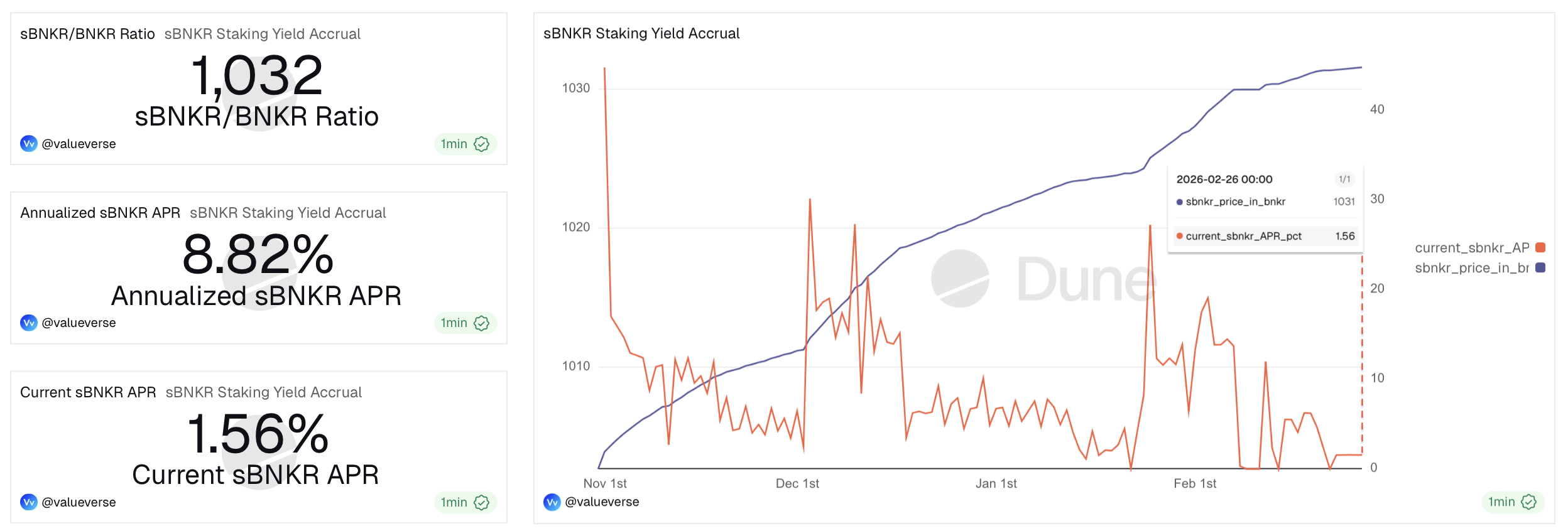
It's worth mentioning a one-time $BNKR buyback event; however only staking is continuous value-accrual stream.
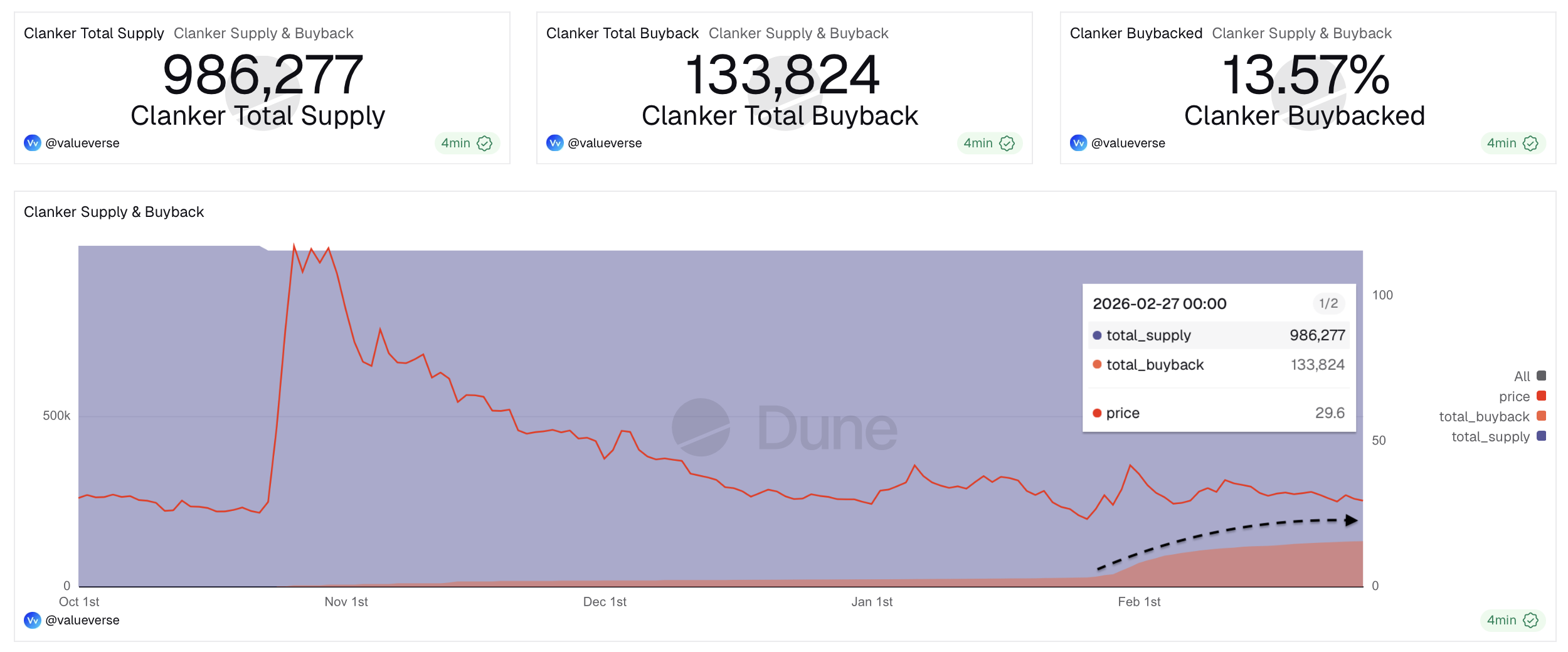
Clanker has distributed over $3M via buybacks. The program launched in late November 2025, but gained meaningful traction only recently: ~75% of $CLANKER buybacks occurred in the last 30 days:
Revenue highlights
- AI sector leaders Virtuals and Venice generate substantial fees. $VIRTUAL does not capture protocol revenue, while Venice's $VVV accrues value through tokenized access rights (via staking) and buybacks.
- Beyond platforms, there are already purpose-built AI agents that generate meaningful revenue and return value to their token holders through mechanisms such as buybacks and staking
- Across the projects discussed, $VVV is the only token with major liquidity and trading volumes on Aerodrome; most others primarily concentrate liquidity on Uniswap (including all Virtuals agents tokens).
Base: Game+AI Sector Revenue
The Game+AI sector on Base is relatively small by revenue but huge on social effect and potentially could become a significant revenue contributor.
For this report it is more like a case study on how Game projects could generate revenue on all levels (on chain, Defi, and AI levels) at the same time.
Clash of Coins ($OWB) is a real-time strategy MMORPG where players fight for control of a global map through territory conquest, strategic battles, alliances, and dynamic AI encounters:
- Recently ranked as #1 popular app on Base.
- Uses AI sector providing real strategy MMO gameplay with AI agents, powered partly by Virtuals
- Potential revenue contributor to Virtuals, Aerodrome, and Base
In the future we expect significant growth of this sector fueled up by social effects, that will continuously generate revenue to AI and Defi sectors.
Disclaimer: This article and the accompanying analysis are provided by Valueverse for research and educational purposes only. All token valuation frameworks, metrics, comparisons, and conclusions discussed herein are experimental in nature and may rely on incomplete, estimated, delayed, or incorrect data, as well as subjective assumptions and methodologies.
The presented analyses do not represent definitive valuations, forecasts, or assessments of financial performance, and should not be interpreted as statements of intrinsic value. Digital assets and tokens are highly volatile, and their economic characteristics may change over time.
Nothing in this publication constitutes investment advice, financial advice, legal advice, or a recommendation to buy, sell, or hold any asset. Readers are solely responsible for their own research, risk assessment, and investment decisions.