Valueverse.

HomePeriodic TableResearchMethodology
  1. Tokens
  2. crvUSD

Valueverse.

The comprehensive platform for cryptocurrency token analysis and value capturing mechanisms exploration.

Platform

  • Tokens
  • Periodic Table
  • Methodology

Resources

  • FAQ
  • Research

Follow Valueverse on X to stay updated on token analysis and market insights

©2025 Valueverse. All rights reserved.
Terms of UsePrivacy Policy
List a Token
crvUSD logo

crvUSD

crvusd
$0.9991
-0.13%
24h Price Range
$0.9953
$1.00
Website
curve.finance
Twitter
@curvefinance
Telegram
t.me/curvefi
Discord
discord.gg/9uEHakc
GitHub
curvefi/curve-contract
Explorers
etherscan.io/token/0xf939e0a03fb07f59a73314e73794be0e57ac1b4e
Market Cap
$334M
Fully Diluted Valuation
$334M
24h Trading Volume
$27.4M
Circulating Supply
334M
Total Supply
334M
All-Time High
$1.11
-9.74%
All-Time Low
$0.9490
+5.21%
7 Days
+0.082%
30 Days
-0.065%
FunctionsFunctions
Value DriversValue
Implementation DetailsImplementation

As a preface, the user should not hesitate to additionally consult the highly superior crvUSD docs should he have unanswered questions. Curve's native implementation of leverage strategies is outside of the scope of the present summary and is best read about in the corresponding documentation section.

0. Markets

crvUSD itself acts as a ERC20 token, with minting and burning mostly restricted to automatic actions undertaken by the Factory contract whenever a new crvUSD market is configured or an existing one's debt ceiling is modified.

A crvUSD market is associated with a Controller, a market AMM (containing the market's collateral and crvUSD) and its parameters, a collateral asset, a debt ceiling, loan and liquidation discounts (determining the amounts allowed for borrowing and the liquidation threshold), and a monetary policy governing the interest rates. These markets are not deployed and managed permissionlessly, but are rather subject to the results of Curve DAO votes.

crvUSD can also be minted as a pre-allocation for other purposes should the DAO consent to that (an example thereof is the allocations made to Yield Basis), but this mechanism exactly matches that of the ordinary crvUSD supply expansion.

1. Creation, management, and liquidation of loans

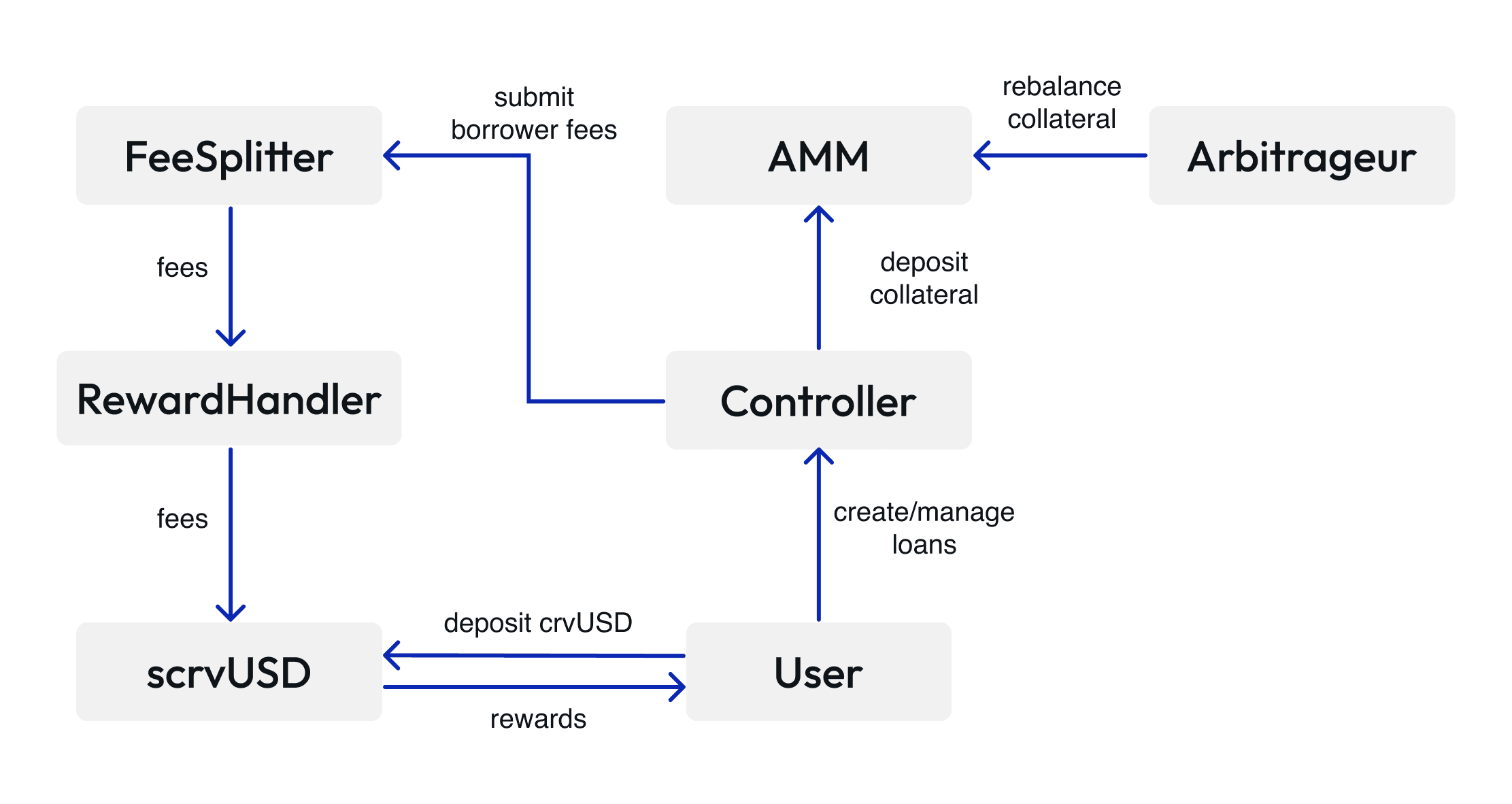
As shown above, crvUSD is not minted, but rather released when a loan is created. The user's interactive endpoint for the purposes of managing and creating loans is a market's Controller contract. When the user invokes the create_loan function of the Controller, he supplies the collateral and specifies the debt (i.e., the number of crvUSD to borrow) and the number of bands (see section 5) to spread the collateral over. Should he wish to repay the loan, an eponymous function is also available. Otherwise, collateral can be managed with add_collateral and remove_collateral, and debt can be increased with borrow_more. Hard liquidations (soft liquidations are automatic and mostly reversible) can be done with liquidate. Callback extensions are available for all these functions.

The amount of debt that can be obtained for a given amount of collateral is naturally dependent on the market parameters, but also on the number of bands the loan is spread over (as it determines the smallest possible price at which some of the collateral yet remains backing the loan). The maximal admitted LTV is determined as:

LTV=1−loan_discount−N2ALTV = 1 - loan\_discount - \frac{N}{2A}LTV=1−loan_discount−2AN​

Where NNN is the number of bands, and both loan_discountloan\_discountloan_discount and AAA are market parameters. The hard liquidation is only possible when the health of the loan is below zero, with the health being bounded from below by

health=(collateral∗(1−liquidation_discount))/debt−1health = (collateral*(1-liquidation\_discount))/debt-1health=(collateral∗(1−liquidation_discount))/debt−1

Its value is increased whenever the user is not in the liquidation mode (i.e., his bands lie entirely above the current band), for which reason we say that the above formula bounds it from below. Data on bands is available in section 5.

2. PegKeepers

PegKeepers are contracts designated for maintenance of crvUSD pegs. Each holds a quantity of crvUSD allotted to it and is permitted to carry out only two actions: deposition of crvUSD into the associated crvUSD/stablecoin liquidity pool and withdrawal therefrom. The intuition is that control over the supply of crvUSD in these pools naturally controls the prices there and therefore also the peg.

The function update that peforms these actions is callable permissionlessly by anyone, and the caller receives a reward to incentivise triggering updates.

3. On the interest rate of crvUSD

MonetaryPolicy contracts are responsible for governing the interest rates on crvUSD loans. These rates are dynamic and depend on a number of parameters and the relation between the amount of crvUSD deposited by the PegKeepers (i.e., indirectly the degree to which crvUSD appreciated above peg) and the total crvUSD debt (DebtFractionDebtFractionDebtFraction). The interest rate per second is computed as follows (σ\sigmaσ, rate0rate0rate0, and TargetFractionTargetFractionTargetFraction are all parameters):

r=rate0⋅epwrr = rate0\cdot e^{pwr}r=rate0⋅epwr

where

pwr=pricepeg−priceoracleσ−DebtFractionTargetFractionpwr = \frac{price_{peg} - price_{oracle}}{\sigma}-\frac{DebtFraction}{TargetFraction} pwr=σpricepeg​−priceoracle​​−TargetFractionDebtFraction​

With pricepegprice_{peg}pricepeg​ being the target price, which is unity.

This interest is paid by all borrowers of crvUSD and automatically compounds onto their debt to increase it. This together with deliquidation and soft liquidaton losses are the two sources of health degradation of loans and can lead to hard liquidation; it is somewhat offset by AMM fees that are paid to liquidity providers of market-associated AMMs (who are, of course, the borrowers themselves). The interest is divided between recipients (except in special cases it is entirely employed for a distinct purpose, as in Yield Basis), of which one is scrvUSD. These fees are paid to a FeeSplitter by the Controllers, whereupon the fees are split between its receivers, with some of the weights possibly being dynamic.

4. scrvUSD

scrvUSD is a vault into which crvUSD is deposited and sits unrehypothecated, accruing rewards (therefore, it follows that scrvUSD is a yield-bearing crvUSD). There are two sources of these rewards: it can either come from donations or from a dynamically allocated portion of crvUSD borrower fees: all the fees that come from the Controllers are split between a number of receivers, of which one is the scrvUSD RewardsHandler; the weight of the Handler is a TWA of the ratio between deposited crvUSD in the Vault and total circulating supply of crvUSD, with a lower bound of 5%. Rewards processing is permissionless; the rewards are streamed to the vault and divided pro rata between the depositors thereto.

5. Further details about LLAMMA

LLAMMA is the other name of the AMM associated with a market; it contains, as stated above, crvUSD and the collateral. Its LPs necessarily include the borrowers of crvUSD. Now we must state a few generalities about LLAMMA. It is not an exhaustive description, for which the reader is referred to dedicated explanations.

Firstly, it must be said that the price line is divided into equally-sized bands, which function like ticks in UniV3. A user specifies the number of bands at loan creation (at least 4 and no more than 50), and the submitted collateral liquidity is distributed equally between all bands in a contiguous range, which forms the total liquidation range of the loan. Once the price of the collateral crosses the upper bound of the loan, it starts being liquidated until the price crosses the lower bound (or rises up above the upper bound as well).

This automatic liquidation is known as soft liquidation because it is (mostly) reversible. This soft liquidation has the effect of linearly rebalancing the collateral of the loan against crvUSD so that the loan becomes secured not purely by the collateral but by a combination of crvUSD and the collateral, with crvUSD taking up a linearly increasing portion, until at last the price crosses the lower bound, at which point the loan is entirely backed by crvUSD. It is still not hard-liquidated, however, if its health is above zero.

Once the price of the collateral reenters the range from below, the loan starts being automatically deliquidated, which is in essence the same process in reverse. As the soft liquidation and deliquidation are powered automatically by arbitrage, it incurs some damage to the loans' health; this is somewhat offset by the AMM fees, which are credited to the LPs (which are the borrowers).

The rebalances, as stated, are automatically powered by arbitrage; there are two oracles, a slowly varying external one and a quickly varying internal one. As such, the price in the LLAMMA falls or rises faster than outside of it, creating a natural arbitrage opportunity in the desired direction.